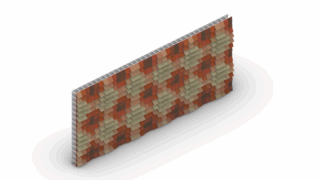
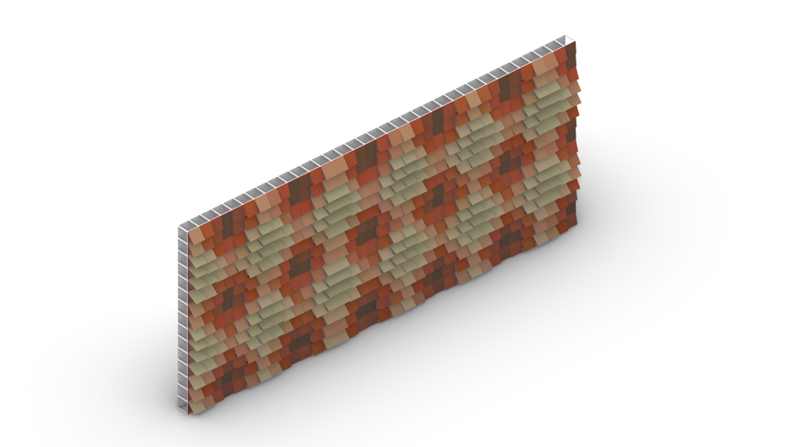
This project explores the design and simulation of a kinetic façade system driven by wind movement, developed using Grasshopper within a Rhinoceros 3D environment. The panels are distributed across a grid structure and respond dynamically to environmental forces, combining parametric architecture with natural phenomena. The goal is to demonstrate how computational tools can translate abstract natural inputs, such as wind, into precise and programmable geometry, creating a façade that feels alive and responsive to its surroundings.
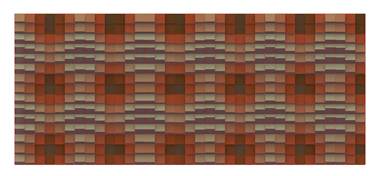
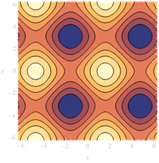
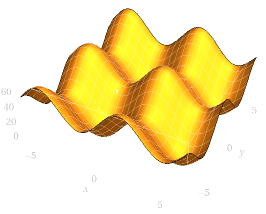
The façade’s behavior is governed by the mathematical function (((sin(x) + cos(y)) × 0.25 + 0.5) × 75), which translates wind patterns into a continuous wave-like displacement across the panel grid. Each panel’s rotation or depth is calculated individually based on its X and Y grid position, producing a fluid, rippling effect that mimics natural airflow. This approach allows precise control over the visual rhythm of the system, creating an alternating depth field that reinforces the perception of movement and environmental interaction.
- Grid Dimensions:
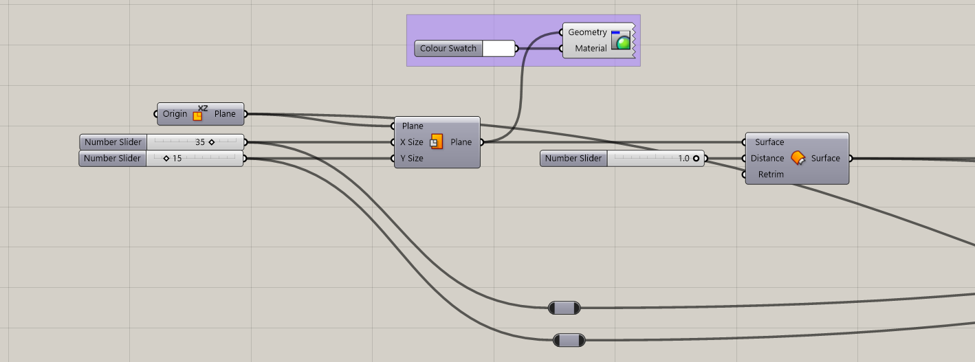
The first step establishes the structural logic of the façade by defining a base surface subdivided into a 35×15 grid of division planes. Two Number Sliders independently control the X and Y dimensions, feeding into a Plane component that positions each cell. A third slider sets the offset distance of 1.0, which determines the depth at which panels will later be placed. This grid becomes the spatial framework that all subsequent panel geometry references.
2. Grid Structure Parameters:
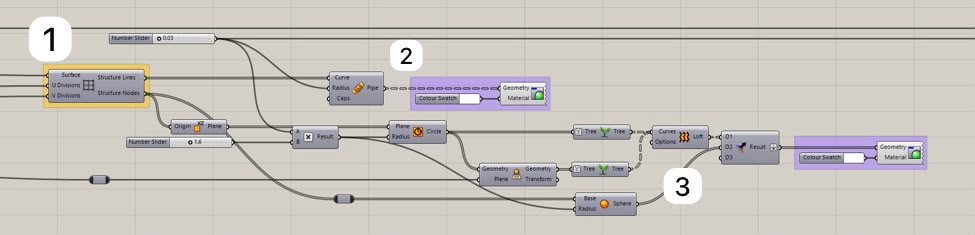
The Lunch Box plugin “Grid Structure” component (1) receives the base surface along with U and V division values, generating both the structural lines and nodes of the grid. From these nodes, a Circle component constructs the frame geometry using a controlled radius, which is then extruded into pipes (2) to form the physical structure. Finally, a Sphere component placed at each node (3) defines the joint connections, with a Loft operation assembling the complete structural mesh.
3. Panels geometry and movement:
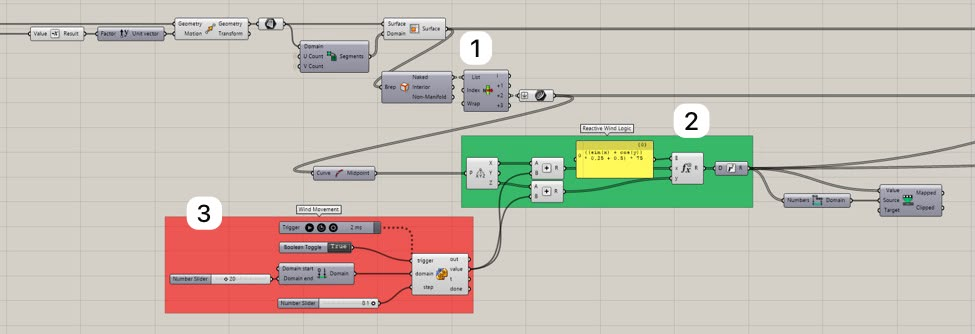
The panel geometry (1) is built by segmenting the base surface into individual faces using Domain and Segments components, extracting each cell’s midpoint to anchor the panel’s local plane. A Unit Vector and Transform component then repositions each panel along its normal direction, establishing the displaced geometry that will receive the movement values calculated downstream.
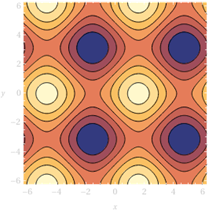
The green cluster (2) contains the core mathematical expression (((sin(x) + cos(y)) × 0.25 + 0.5) × 75), evaluated per panel using each cell’s X and Y grid coordinates as inputs. This produces a unique displacement value for every panel, creating the wave-like depth variation visible across the façade. The red Animation component (3) then drives this function automatically over time using a looped Domain range, simulating continuous wind-driven movement across the entire grid.
4. Python integration
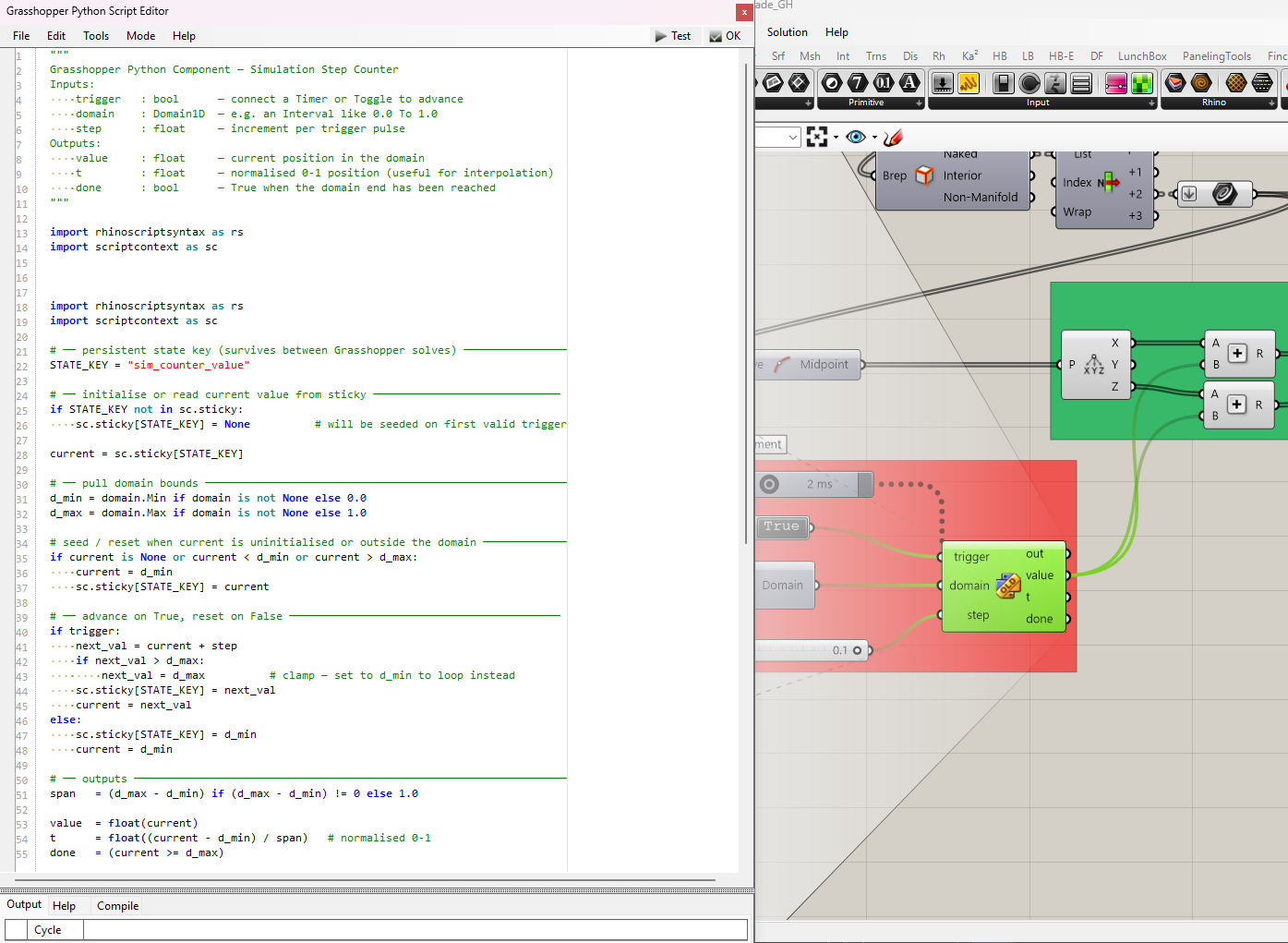
To automate the wind movement, I used Claude (Anthropic’s AI assistant) to write a custom Python component that works as a simulation step counter. Its function is to advance a numeric value across a defined domain, for example from 0.0 to 1.0, each time it receives a trigger pulse from a Timer or Toggle. The code stores the current position persistently using Grasshopper’s “sticky” memory, so the value survives between solver updates rather than resetting. On each pulse it increments by a set step, and once it reaches the domain’s upper limit it loops back to the start, producing continuous motion. It also outputs a normalised 0–1 value, which feeds directly into the mathematical function driving the panels. This lets the façade animate automatically and smoothly without manual input.
5. Panel design:
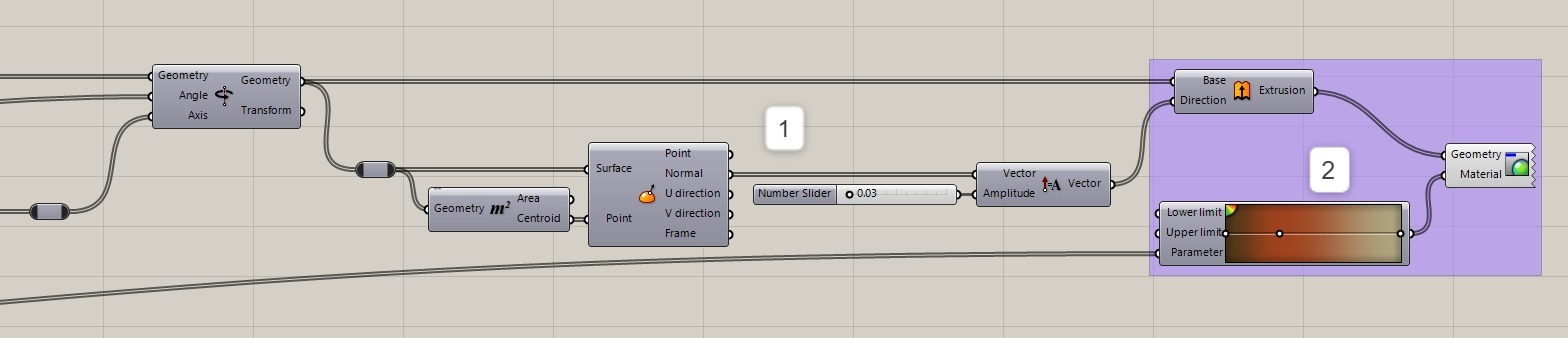
The final step defines each panel’s physical form and material. Component (1) extracts the surface area, centroid, and local frame of each grid cell, using the Normal and V-direction vectors to orient the panel correctly in 3D space. A Number Slider controls the amplitude of this orientation. Component (2) then extrudes the base geometry along that vector direction and applies a gradient material, completing the façade with both geometric depth and visual finish.
Conclusion:

This project demonstrates how parametric tools within Grasshopper can translate a natural phenomenon, such as wind movement, into a precise, programmable architectural system. By building the workflow in sequential layers, from grid definition and structural framing to mathematical animation and panel materialization, the façade achieves a coherent logic where every component serves the overall dynamic behavior. The mathematical function (((sin(x) + cos(y)) × 0.25 + 0.5) × 75) proves that relatively simple expressions can generate complex, organic-feeling results at an architectural scale. Ultimately, the project positions computational design not as a stylistic tool, but as a method for embedding environmental responsiveness directly into building geometry.
Animation:
Grasshopper file:
Tutorial made by Renato Ampuero Mella