Biological introduction:
Based on “Brood comb construction by the stingless bees Tetragonula hockingsi and Tetragonula carbonaria.” by Rute M. Brito · Timothy M. Schaerf · Mary R. Myerscough · Tim A. Heard · Benjamin P. Oldroyd.
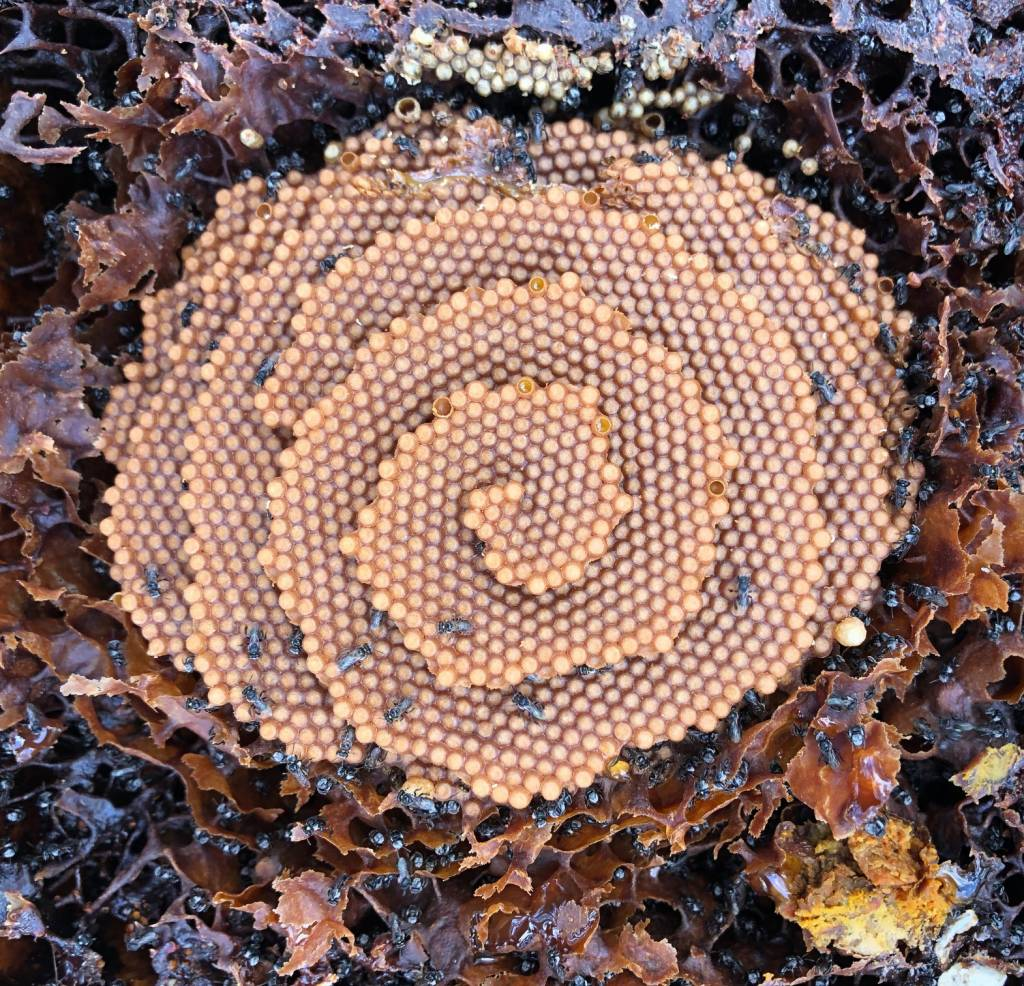
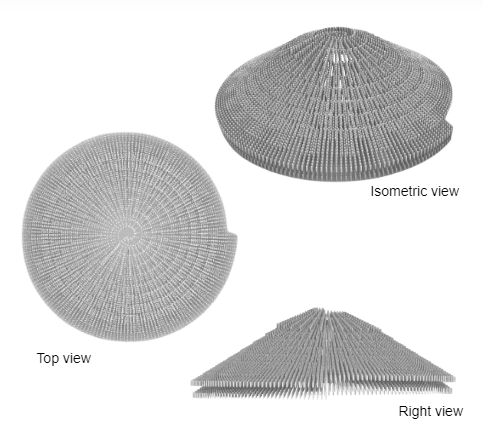
The brood comb of Tetragonula carbonaria has a compact spiral architecture. Unlike a flat honeycomb grid, this structure grows as a continuous three-dimensional spiral, where brood cells are connected to neighboring cells with almost no gaps between internal cells.
Growth logic of the comb:
The construction starts from the center of an existing layer. New cells are then added beside existing cells, especially in the clefts formed by two or three neighboring cells. The paper explains that the spiral appears because each new cell is built slightly higher than the previous one, following either a clockwise or anticlockwise direction.
Translation into Grasshopper:
- Sequence of values from the center toward the outside of the comb:

Instead of drawing each cell manually, the model first creates a spiral path that represents the direction of growth of the brood comb. The first part of the script uses:
Construct domain → Range
This creates a sequence of values from the center toward the outside of the comb. The Range component creates a list of numbers between 0 and 1.
x = 0 → Beginning of the spiral
x = 1 → End of the spiral
Represents the progress of the comb growth.
2. Model control parameters:

3. Creating the spiral:
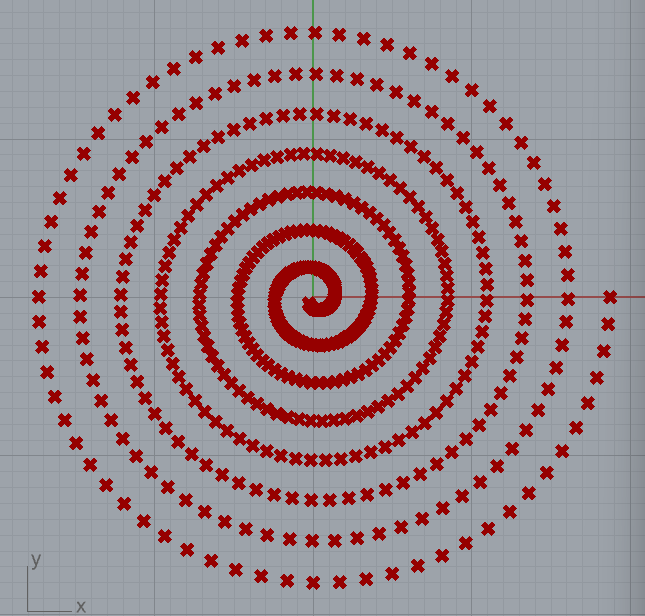
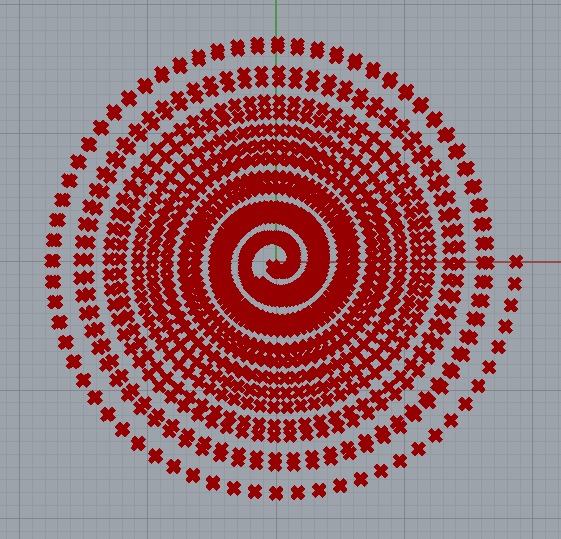
The values from Range are connected to three Expression components.
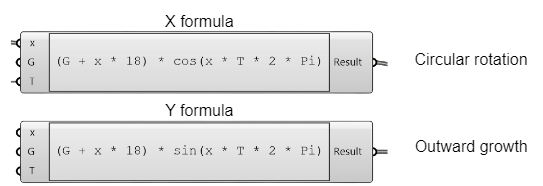
The X and Y expressions generate the circular spiral movement:
The Z expression creates the vertical variation:

x = growth progress
T = number of turns
C = cell height
The Range component represents the growth sequence from the center outward. The X and Y formulas use sine and cosine to create circular movement, while the radius increases with x, transforming the circle into a spiral. The Z formula adds gradual height variation based on the cell height.
4. The first spiral is duplicated to create a second spiral curve:
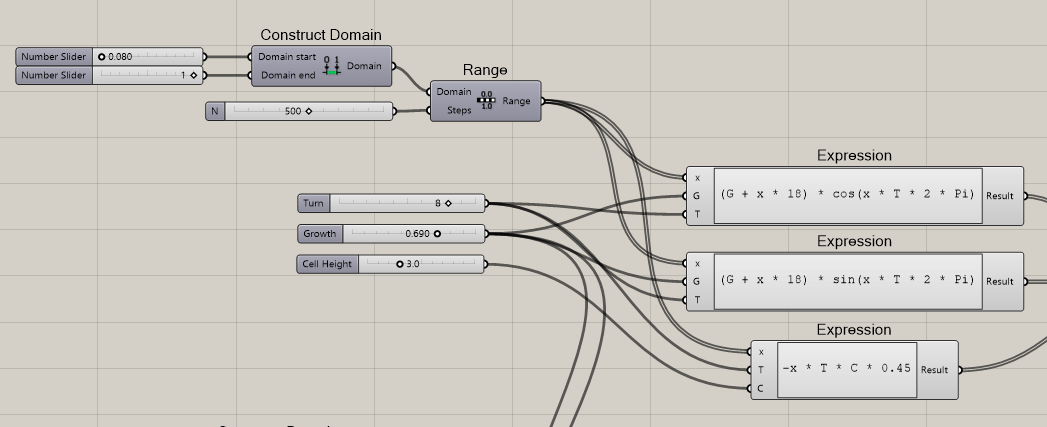
When x = 0, the second spiral uses the same radius as the first one, so there is no unwanted line at the beginning. When x = 1, the formula reaches the second growth value, H, creating the thickness of the spiral band. This helps the model form a clean comb surface instead of two disconnected spirals.
x = growth progress
T = number of turns
C = cell height
H = first growth progress
5. Creating the band of the comb:
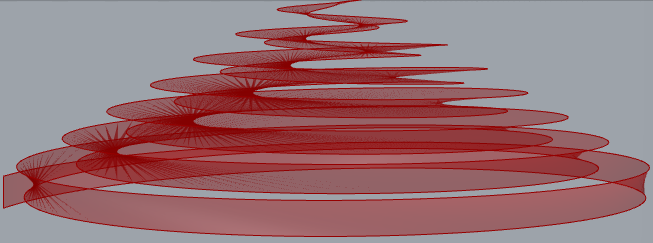
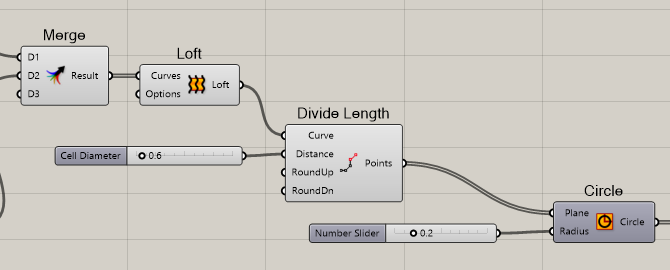
The first spiral is duplicated to create a second spiral curve. These two curves are joined using: Merge → Loft.
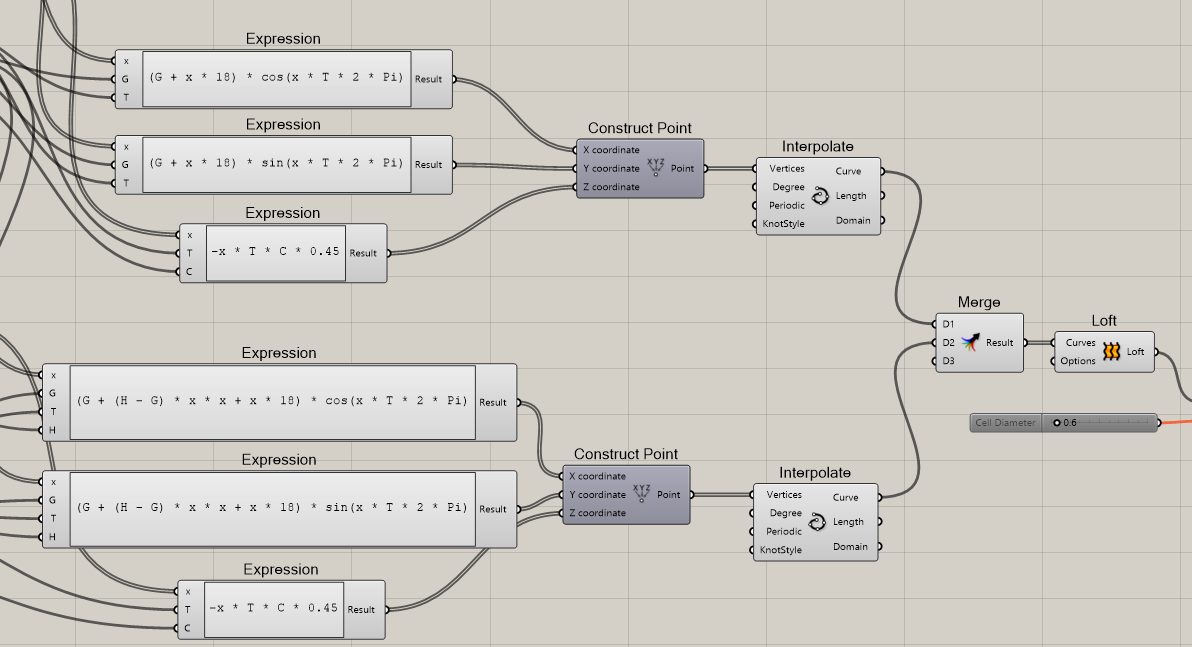
The Loft creates a surface or band between the two spiral curves. This represents the thickness of the brood comb.
6. Dividing the band:
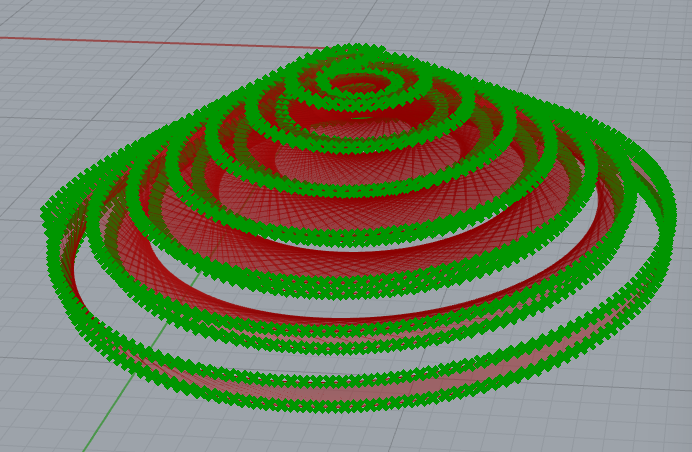
Divide Length → This places points along the spiral band. These points become the possible positions for the brood cells.
Circle → Divide Curve This generates additional points around the curve, helping to fill the surface so the model does not look like a single line of cells.
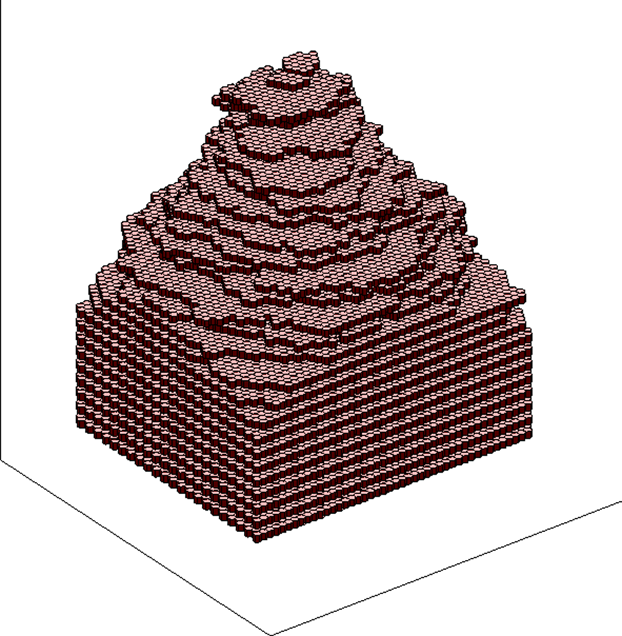
After creating the surface, I divide it into points. These points define where the brood cells will be placed. I also use Circle and Divide Curve to create more points around the spiral, so the model becomes denser and does not look like only one line of cells. This helps represent the compact organization of the natural comb.
7. Modeling the brood cells:
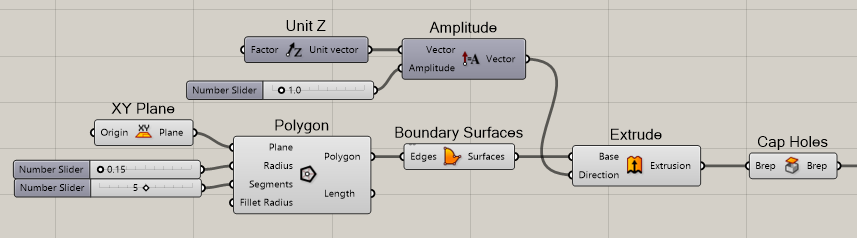
Each cell is created using:
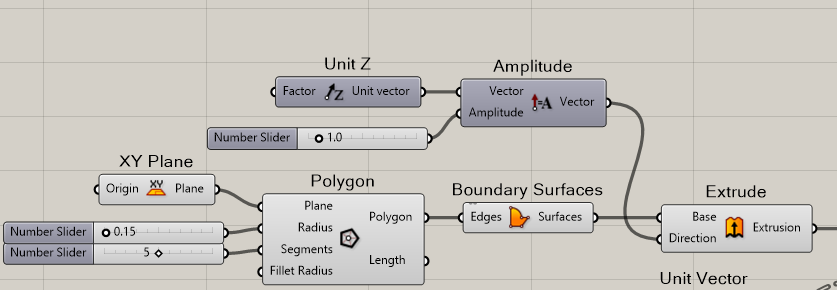
XY Plane → Polygon
The flat hexagon is then converted into a 3D cell with:
Boundary Surfaces → Extrude → Cap Holes
Each brood cell is modeled as a hexagon using Polygon with six sides. Then, I turn the flat hexagon into a 3D object using Boundary Surfaces, Extrude, and Cap Holes. This creates closed three-dimensional cells that form the visible structure of the comb.
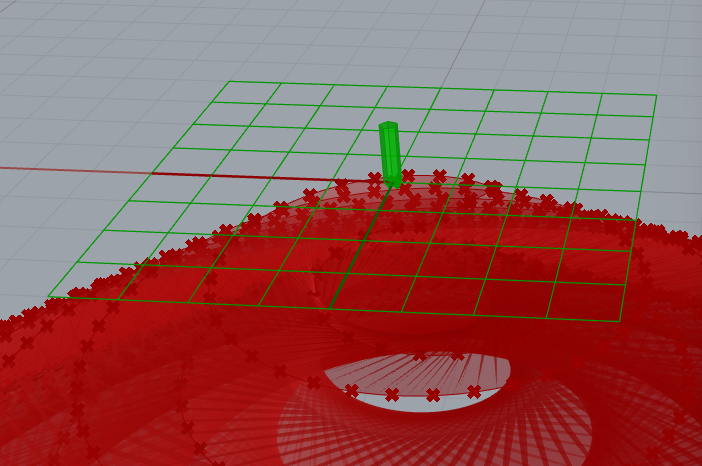
8. Point Distribution and Filling System:
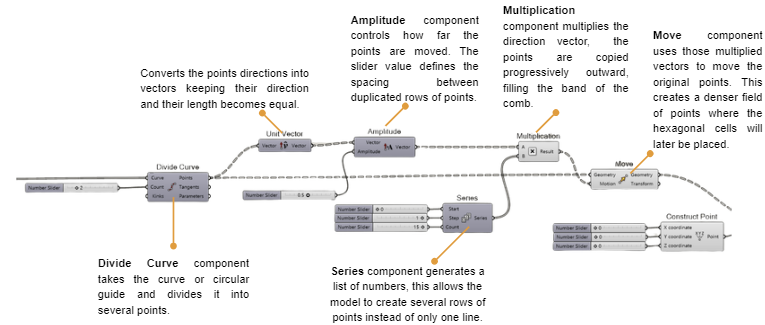
9. Hexagonal cells onto the generated point field:
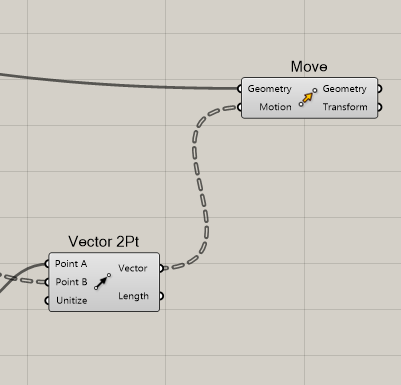
Vector 2Pt creates a movement vector from a starting point, usually the origin, to each target point on the spiral band.
Move component uses those vectors to copy the hexagonal cell geometry from the origin to every point on the comb.
10. Conclusion:
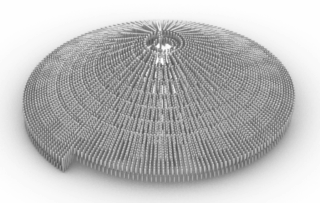
This Grasshopper definition transforms the biological rules of Tetragonula carbonaria into a parametric model. The spiral curve represents the growth direction, the lofted band represents the compact surface of the brood comb, and the extruded hexagons represent the individual brood cells.
The final result is not a flat honeycomb pattern, but a three-dimensional spiral structure that approximates the natural architecture of Tetragonula carbonaria.